

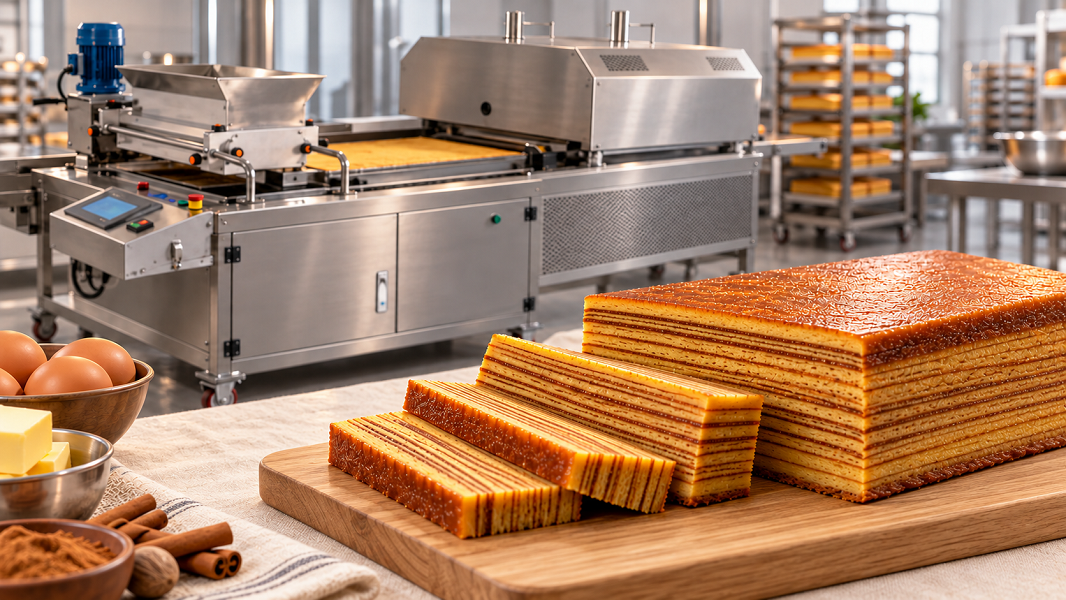
Lapis legit, also known as Indonesian layered cake or spekkoek, is one of the bakery products that requires a high level of precision during production. Its distinctive characteristics include neatly arranged thin layers, uniform coloring, and a dense yet soft texture. To achieve this level of quality, every stage of production must be carried out precisely, from controlling the amount of batter and baking time to maintaining the appropriate temperature.
In small-scale production, these processes can still be managed manually. However, as order volumes increase, maintaining consistent layer thickness and doneness becomes more challenging. Differences in techniques between operators, fatigue during production, and variations in baking time can all lead to inconsistent results. This is where automatic lapis legit machines play an important role.
Automatic lapis legit machines are designed to help manufacturers manage production processes with greater precision and control. The machine’s system can assist in regulating several critical stages, including baking pan positioning, baking duration, temperature, and layer-forming cycles. The objective is not simply to accelerate production but also to maintain consistent product quality from one batch to another.
Why Does Lapis Legit Production Require High Precision?
Unlike conventional cakes, which are generally baked in a single process, lapis legit is produced through repeated baking cycles. Small amounts of batter are poured into a baking pan, and each layer is baked before the next portion of batter is added. This process continues until the desired number of layers has been achieved.
If the amount of batter added is inconsistent, the thickness of each layer may vary. If the baking time is too long, the surface may become excessively dark or dry. Conversely, if the baking time is too short, the layers may remain undercooked, affecting the cake’s overall texture.
In manual production, experienced operators can usually control these processes effectively. However, when production involves large quantities and extended operating hours, maintaining consistency becomes a significant challenge. Even minor variations in the process can become clearly visible when the cake is sliced.
For this reason, many bakery businesses are beginning to incorporate machinery into their operations to maintain more uniform production standards.
How Automatic Lapis Legit Machines Work
In principle, automatic lapis legit machines follow the same fundamental method used in traditional lapis legit production. The main difference lies in their more systematic process control.
Prepared batter is placed into a feeding system or holding container, depending on the machine’s design. The baking pan is then positioned within the designated working area. Once the production parameters have been configured, the machine performs repeated baking cycles according to the selected settings.
Each layer undergoes relatively consistent processing. Factors such as the amount of batter, the position of the baking pan relative to the heat source, and the baking duration can be controlled more uniformly. Once one layer is completed, the process continues with the next layer until the product reaches the desired height.
With proper settings, operators no longer need to rely continuously on manual estimates. The production process becomes easier to replicate because the machine operates according to predetermined parameters.
Batter Control Determines Layer Uniformity
One of the primary factors in producing neat and uniform layers is the amount of batter used in each cycle.
In manual production, operators must ensure that the batter volume remains relatively consistent from one layer to another. If too much batter is added, the resulting layer will be thicker. If too little is used, the layer will appear excessively thin.
Even minor differences can become noticeable when the finished product is sliced and arranged in its packaging.
Machines help make batter dispensing more precise and measurable. With a more consistent amount of batter, layer thickness can also become more uniform. As a result, the finished lapis legit has a neater appearance and a more consistent layered pattern.
This is particularly important for manufacturers selling products in premium packaging, gift hampers, or retail distribution channels, where visual presentation often plays a significant role in consumers’ purchasing decisions.
Temperature Control Helps Maintain Proper Baking
In addition to batter quantity, baking temperature has a major influence on the final product.
Each layer must reach the appropriate level of doneness before the next layer is added. If the temperature is too high, the surface may darken quickly before the interior is fully cooked. If the temperature is too low, the baking process becomes slower, potentially affecting the cake’s texture.
Machines equipped with temperature control systems allow operators to set the temperature according to the characteristics of the recipe being used. With more stable temperatures, the baking process can be performed more consistently.
Temperature stability also helps reduce color variations across different sections of the cake. In large-scale production, this level of control is essential because manufacturers need to maintain a uniform product appearance.
Consistent Baking Time
The baking duration for each layer must be carefully controlled. Significant differences in baking time can affect the cake’s color, softness, and level of doneness.
In manual production, operators typically rely on timers or visual observation. When production volumes are relatively low, these methods can still be effective. However, as production increases, the risk of delays and inconsistencies also becomes greater.
Automatic machines can help regulate baking duration based on predetermined parameters. This allows each layer to receive a more uniform amount of heating time.
Of course, the baking duration must still be adjusted according to the recipe, baking pan dimensions, batter thickness, and desired product characteristics. A machine does not replace a well-developed recipe; instead, it serves as a tool to execute that recipe more consistently.
Heat Distribution Also Plays an Important Role
In addition to temperature, heat distribution within the baking area must also be considered.
If heat is concentrated on one side, certain sections of a layer may bake faster than others. As a result, the surface color may become uneven, and the texture may also vary.
A well-designed heating system helps maintain more stable heat distribution. With more even heat distribution, the entire surface of each layer receives relatively uniform heat exposure.
This helps produce more consistent coloring while minimizing the possibility of certain sections becoming overbaked or underbaked.
More Controlled Baking Pan Movement
In manual lapis legit production, baking pans must be repeatedly moved in and out of the baking area. This activity requires considerable physical effort and attention to detail.
Even a slight delay can affect the quality of a layer. Additionally, changes in baking pan positioning may result in different levels of heat exposure.
With automatic or semi-automatic machines, baking pan movement can be controlled more systematically. The pan’s position relative to the heat source can be maintained, while the operating cycle follows predetermined settings.
By establishing a more consistent production rhythm, variations caused by differences in operator techniques can be reduced.
Easier Production Standardization
One of the primary advantages of using machinery is that production processes become easier to standardize.
Once manufacturers have identified the ideal combination of temperature, baking duration, batter quantity, and machine settings that produces the desired quality, these parameters can be reused in subsequent production runs.
This makes the production process more repeatable. Companies no longer need to depend entirely on the expertise of a particular operator.
Standardization also becomes valuable as a business expands and hires additional employees. New operators can follow established procedures, making the training and adaptation process more structured.
Suitable for Higher-Volume Production
Demand for lapis legit often increases during certain periods, such as religious holidays, year-end celebrations, corporate events, and gift hamper seasons.
If the production process remains entirely manual, production capacity can become a limiting factor. Hiring additional workers may help, but it does not always resolve consistency issues.
Machinery helps improve efficiency by making several production stages more structured. Operators can allocate more time to other activities, such as preparing ingredients, performing quality control, handling packaging, or managing production workflows.
For growing manufacturers, this can help increase production capacity without significantly increasing their dependence on manual labor.
Reducing the Risk of Products Failing to Meet Quality Standards
Defective products or products that fail to meet established quality standards can increase production costs.
In lapis legit production, quality issues may appear in various forms, including excessively thick layers, overly dark surfaces, undercooked sections, or color differences between batches.
With better-controlled processes, these variations can be minimized. Machines help ensure that each production stage operates according to more stable parameters.
The fewer defective products produced, the more efficiently raw materials can be utilized. This is particularly important because key lapis legit ingredients, such as eggs, butter, sugar, and other premium ingredients, can represent a substantial portion of production costs.
Machine Settings Must Still Be Adjusted to the Recipe
Using a machine does not automatically guarantee perfect results without proper configuration.
Every recipe has different characteristics. Batter viscosity, fat content, egg quantity, baking pan dimensions, and layer thickness can all influence the baking process.
Therefore, manufacturers still need to conduct production trials to determine the most suitable parameters.
Once the appropriate settings have been identified, they should be documented as part of the production standards. This makes it easier to maintain consistent results, even when production takes place on different days or is handled by different operators.
Machine Maintenance Should Not Be Overlooked
Production consistency also depends heavily on the condition of the equipment.
Machine components that come into contact with food ingredients must be cleaned regularly. Batter residue, grease, and other material deposits can compromise hygiene and affect component performance.
Heating systems, sensors, movement mechanisms, and control components should also be inspected periodically.
Preventive maintenance helps identify potential problems before they develop into major equipment failures. For businesses with demanding production schedules, keeping machines in optimal condition also helps reduce the risk of downtime that could disrupt order fulfillment.
Automation Must Preserve the Product’s Unique Characteristics
Using machinery does not mean manufacturers have to sacrifice the distinctive qualities of their products.
Flavor, aroma, texture, sweetness, and ingredient quality are still determined by the recipe. The machine primarily functions as a tool to help execute the production process more consistently.
By combining well-developed recipes, high-quality ingredients, and appropriate machine settings, manufacturers can preserve their products’ unique characteristics while improving production efficiency.
This makes automation relevant not only for large companies but also for growing bakery businesses seeking to establish more consistent production systems.
As production capacity requirements increase, investing in an automatic lapis legit machine can be an effective step toward maintaining product quality without excessively increasing the manual workload. A more controlled production process also makes it easier for businesses to meet the demands of resellers, retailers, hotels, corporate clients, and markets requiring larger supply volumes.
For food industry businesses seeking reliable production equipment solutions, ProFood Machines offers a range of machines designed with practical operational requirements in mind.
ProFood Machines proudly designs and assembles its products entirely in Indonesia. This commitment reflects the company’s dedication to promoting domestically manufactured products and its confidence in the strength and potential of local manufacturing capabilities.
Indonesia’s manufacturing industry continues to develop and holds significant potential to produce machinery capable of meeting market demands while maintaining globally competitive standards. Through its domestic product development initiatives, ProFood Machines aims to contribute to the growth of the local manufacturing ecosystem while providing solutions that better address the needs of the food industry.
For bakery businesses and food manufacturers looking to improve production efficiency, consistency, and capacity, more information about the machinery solutions offered by ProFood Machines is available at https://profoodmachines.com/.

