

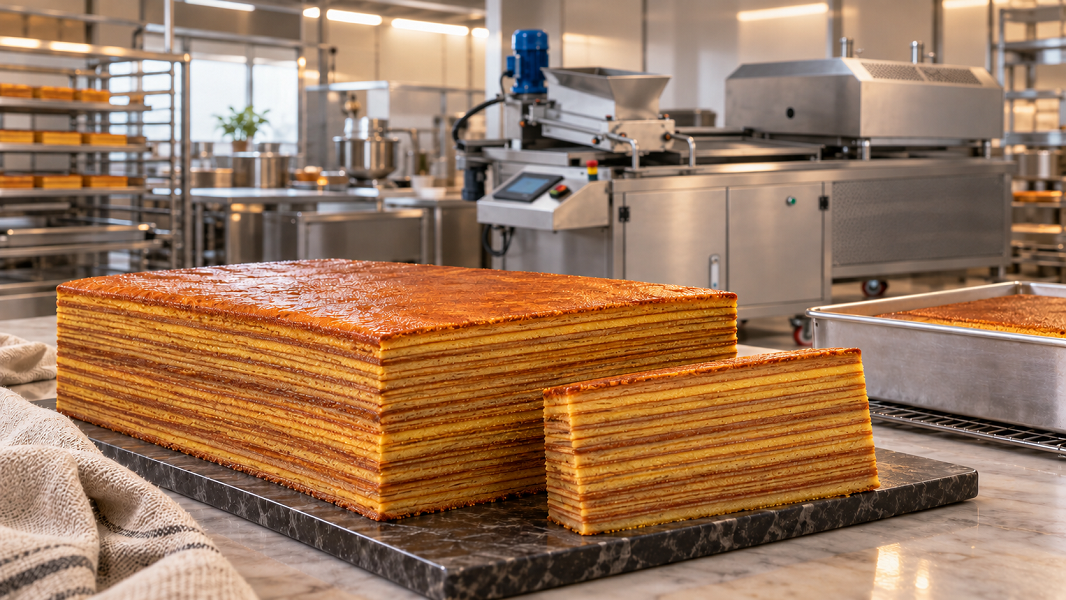
Lapis legit is a premium bakery product that demands considerable precision during preparation. This cake is characterized by thin layers built up gradually to create a dense yet soft texture and a distinctive appearance. As a result, producing lapis legit requires more attention than many other types of cake.
At home or on a small scale, lapis legit can still be made manually. However, as order volumes grow, manual production can present several challenges. Layer thickness may vary from one product to another, baking times may become inconsistent, labor requirements increase, and production capacity can be difficult to expand quickly.
In these circumstances, a lapis legit machine can help improve production efficiency. Such equipment allows certain processes to be carried out with greater control, enabling manufacturers to maintain quality while increasing capacity.
Nevertheless, choosing a machine should not be based solely on price or maximum capacity. Every business has different needs, so the selected machine must suit the product’s characteristics, production targets, available facilities, and business growth plans.
First, Understand Your Lapis Legit Production Needs
Before looking for a lapis legit machine for your business, the first step is to understand your production requirements thoroughly. Consider how many cakes you produce each day, how many operators are involved, how many production hours are available, and how much demand is expected to grow over the next few years.
This information matters because machine capacity must match business conditions. If a machine is too small, production may still encounter bottlenecks when orders increase. Conversely, purchasing a machine with capacity far beyond your needs can make the initial investment less efficient.
Ideally, choose a machine that can meet current production requirements while providing room for business growth. Manufacturers should also consider demand patterns. If orders surge ahead of holidays or during particular seasons, peak-period production capacity should factor into the decision.
Layer Consistency Is a Key Consideration
One of the defining features of lapis legit is its neat, consistent layers. Therefore, a machine’s ability to help produce uniform layer thickness is an important selection criterion.
In manual production, the amount of batter poured at each stage depends heavily on the operator’s skill. An experienced operator may be able to maintain relatively consistent thickness. However, results can vary when production volumes rise or multiple operators work on the same team.
Variations in layer thickness affect more than appearance. They can also influence texture, doneness, product weight, and the final appearance after slicing. A lapis legit production machine that allows more precise process settings can therefore help businesses maintain product consistency.
Consistency becomes even more important when products are sold through multiple branches or reseller networks. Customers generally expect the same quality with every purchase. Production standardization is one of the keys to delivering that consistent customer experience.
Look for Flexible Layer-Thickness Settings
Every lapis legit manufacturer has its own product standards. Some products feature very thin, dense layers, while others have slightly thicker layers. For this reason, flexibility in adjusting layer thickness is worth considering.
A machine with a wider range of adjustable settings gives manufacturers room to adapt the process to their own recipes. This capability can also support future product development.
For example, a business may want to introduce several varieties with different layer thicknesses or numbers of layers. An adjustable machine makes experimentation easier without requiring major changes to the production system. This flexibility is particularly important for companies planning to expand their product range or create special variants for specific customers.
The Baking System Must Deliver Consistent Results
Besides layer thickness, baking is a critical part of lapis legit production. Each layer must receive heat for the appropriate amount of time to achieve the desired doneness, color, and texture.
If baking time is too short, a layer may be undercooked. If it is too long, the color may become too dark or the texture may change. When choosing a lapis legit machine, examine how the baking system works and how much control it provides over processing parameters.
The ability to set processing times helps manufacturers standardize production. Once suitable settings have been established for a recipe, they can serve as a reference for subsequent batches.
Even so, each recipe has its own characteristics. Ingredients such as eggs, sugar, flour, butter, margarine, and others can affect baking. Therefore, the machine should be tested using the actual formulations employed by the business.
Ease of Operation Affects Productivity
The technology in a machine should help operators rather than make their work more complicated. An easy-to-understand operating system shortens training time and reduces the likelihood of errors.
This is especially important for businesses with multiple operators or rotating shifts. When a machine has clear controls, operators can follow parameters established by the company. Consequently, production results become less dependent on any one individual.
However, machine operation must still be supported by Standard Operating Procedures (SOPs). These can cover machine preparation, parameter settings, production steps, quality checks, cleaning, and troubleshooting procedures.
Combining user-friendly equipment with well-structured SOPs makes it easier for a business to maintain a consistent production process.
Match the Machine to Your Baking Pan Sizes
Baking pan dimensions should also be considered when choosing a lapis legit machine. Manufacturers typically already have standard product sizes. Those dimensions affect pan selection, the number of portions, cooling, and packaging methods.
Ideally, the machine should be compatible with the pan sizes currently used or planned for future use. Larger pans can increase output per cycle, but they are not necessarily the best choice in every situation.
Consider the entire production flow. Make sure the resulting product dimensions are compatible with worktables, cooling racks, cutting equipment, and packaging areas. Looking at the process as a whole helps maximize the value of the machinery investment.
Consider Materials and Ease of Cleaning
Hygiene is essential in food manufacturing. Machines used to make lapis legit must be maintained regularly to prevent batter remnants and production residues from accumulating.
Prospective buyers should therefore examine the materials used in food-contact parts and the machine’s overall design. Materials should be suitable for food processing and easy to clean.
Also consider whether key components are readily accessible during cleaning. Before purchasing, ask for an explanation of the cleaning procedures. Find out which parts must be cleaned after production, which components can be removed, and whether special tools are needed for maintenance.
A machine that is easy to maintain can help reduce production downtime.
Calculate Your Production Space Requirements
Machine dimensions are another important consideration. You do not want to purchase a machine only to discover that the production area is too cramped for effective operation.
Measure the available space before selecting equipment. Account not only for the machine’s footprint but also for the space operators need to move around, carry baking pans, perform inspections, clean the machine, and carry out maintenance.
Technician access is also important. Placing a machine too close to a wall or other equipment can make servicing difficult.
In addition, plan the layout around the production flow. The machine’s position should make it easy to move products from the preceding stage through baking, cooling, cutting, and packaging. An efficient flow reduces unnecessary movement and helps improve team productivity.
Include Energy Consumption in Production Cost Calculations
When purchasing a machine, the initial price often receives the most attention. Yet long-term operating costs also need to be calculated. Electricity, gas, maintenance, labor, and spare parts all affect operating expenses.
For this reason, a machine’s energy consumption should be calculated and included in the cost of goods manufactured. For example, a company can determine hourly energy costs and compare them with the number of products produced during that period.
This provides an estimate of operating cost per pan or per product. Such an approach helps businesses assess whether a machine genuinely improves efficiency rather than merely increasing production capacity.
Do Not Overlook Maintenance and Spare Parts Availability
Production machines are long-term assets, so after-sales support is an important part of the investment decision.
Before selecting a machine, investigate maintenance services, technician availability, and how easily spare parts can be obtained. Downtime can cause losses, especially when a machine plays a critical role in daily production.
The longer a machine remains out of service, the more orders may be delayed. Access to technical support can help resolve problems faster.
Preventive maintenance is just as important as repairs. Regular servicing helps maintain machine performance and identify problems before they develop into more serious failures. Manufacturers should establish a maintenance schedule suited to how intensively the machine is used.
Conduct a Trial Using Your Own Recipe
One of the best ways to determine whether a machine is suitable is to run a trial with your production recipe. Every batter has different characteristics. A machine that produces excellent results with one recipe may require different settings for another.
Direct testing therefore gives a more realistic picture. During a trial, do not focus solely on machine speed.
Evaluate overall product quality, including layer thickness, color, doneness, texture, final weight, and appearance after slicing.
Also observe the operator’s experience using the machine. Are the settings easy to adjust? Does the workflow feel efficient? Does cleaning take too long?
These observations will help the company make a more informed decision.
Consider the Total Cost of Ownership
The machine’s price is only one part of the investment. To gain a more accurate understanding, businesses should calculate the total cost of ownership.
This calculation can include the purchase price, installation, energy use, maintenance, spare parts, operator requirements, potential downtime, and estimated service life.
This approach allows two machines with different prices to be compared more objectively. A machine with a higher upfront price is not necessarily more expensive over the long term.
If it operates more efficiently, is easy to maintain, and comes with reliable technical support, its total operating cost may be more competitive. Conversely, a machine with a low purchase price may be less economical if it breaks down frequently or spare parts are difficult to obtain.
Align the Investment with Your Business Growth Plans
Machinery purchases should not be based only on today’s requirements. Consider where the business is heading over the next few years.
If the company plans to increase capacity, open new branches, enter retail chains, or expand distribution, its equipment should be able to support that growth.
The same applies to product diversification. In the bakery industry, business growth often creates demand for other types of equipment depending on the products being developed, such as a cookie depositor machine, cookie extruder machine, cream injector machine, layer cake machine, or mini encruster machine.
However, machinery purchases should still follow clear priorities. Not every process needs to be automated at once.
First, identify the production stages that consume the most time, require the most labor, or create bottlenecks. The company can then decide which investments will deliver the greatest impact.
Lapis Legit Machines as Part of Production Standardization
For growing businesses, one of the biggest challenges is not simply increasing output but maintaining quality at higher volumes.
Producing 20 pans of consistent-quality cakes may be relatively manageable by hand. The challenge changes when volume rises to dozens or even hundreds of pans over a given period.
This is where machinery can become part of a standardized production system. With more precisely defined parameters, processes can be replicated more consistently.
Operators no longer have to rely solely on estimates or individual experience; they have standards to follow. This also makes it easier to train new employees.
As a company grows and hires more operators, machines combined with clear SOPs can help maintain quality even as the production team expands.
Take Your Time Choosing a Lapis Legit Machine
Purchasing production equipment is a long-term investment, so the evaluation process deserves careful consideration.
Compare your production requirements with the machine’s capabilities. Examine the flexibility of its settings, space requirements, energy consumption, ease of cleaning, and technical support. Do not focus solely on the highest capacity or lowest price.
The ideal machine is one that fits the business’s production system and can be used effectively over the long term.
If possible, discuss your requirements directly with the machine manufacturer. Explain your product’s characteristics, target capacity, pan dimensions, and current production challenges. This discussion can help identify a more suitable configuration than choosing based only on written specifications.
It’s Time to Increase Lapis Legit Production with the Right Machine
Choosing the right lapis legit machine for commercial-scale production requires consideration of many factors. Production capacity, layer consistency, adjustable settings, the baking system, pan dimensions, energy requirements, production layout, maintenance, and after-sales service all determine whether the investment is appropriate for the business.
For businesses looking to scale up their production of layered cakes or lapis legit, the ProFood LC 278 Automatic Layer Cake Machine is one option worth considering. The machine is designed to provide greater control over the layered cake production process, helping manufacturers establish more consistent and structured operations.
ProFood Machines proudly designs and assembles its products entirely in Indonesia. This commitment is part of its effort to encourage the use of domestically manufactured products while demonstrating confidence in the strength and potential of Indonesian manufacturing to produce machinery that meets industrial needs and global standards.
In addition to supplying production equipment, ProFood Machines provides support to help customers operate and maintain their machines. This is important for businesses that rely on machinery as part of their long-term production operations.
If you are considering automating your lapis legit production and would like to learn more about the LC 278 Automatic Layer Cake Machine, visit https://profoodmachines.com/ for information about products and solutions suited to your business needs.

