

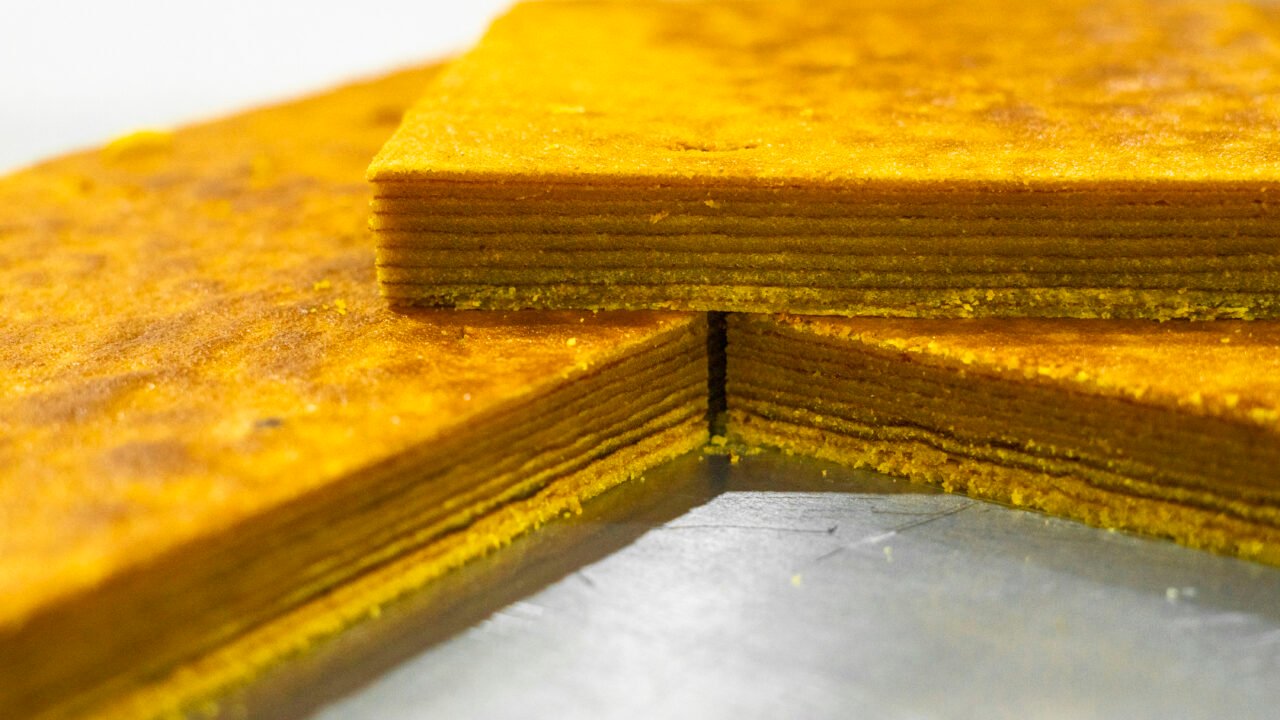
Lapis legit, also known as Indonesian layer cake, is a bakery product with a unique production process. Unlike conventional cakes, where the batter can be poured into a pan and baked all at once, lapis legit is made by building the cake layer by layer. Each layer needs to have a relatively uniform thickness, be baked for the appropriate amount of time, and then be followed by the next layer until the desired number of layers is achieved.
This process is one of the reasons why producing lapis legit in large quantities requires a high level of precision, time, and labor. With a manual method, operators must repeatedly pour the batter, level the surface, bake each layer, and continue the same process consistently until the cake is complete.
When production volumes are still relatively small, manual production may work effectively. However, as demand increases, maintaining product consistency from one batch to another becomes increasingly challenging. Small differences in the amount of batter, baking time, or operator technique can affect the final result.
For bakery businesses looking to increase production capacity without sacrificing consistency, using a lapis legit machine can be one solution. Automation helps transform a process that previously relied heavily on manual skills into one that is more measurable, easier to control, and simpler to standardize.
Why Does Lapis Legit Production Require a High Level of Precision?
One of the defining characteristics of lapis legit is its neat arrangement of thin layers, which is clearly visible when the cake is sliced. To achieve this appearance, each layer needs to have a relatively uniform thickness.
In manual production, consistency depends heavily on the operator’s experience and attention to detail. The amount of batter poured, the way the surface is leveled, and the baking time must be repeated according to the same standard. As production volume increases or operators become fatigued, the possibility of variations between products also increases.
Uneven layer thickness can affect the appearance of the finished product. Differences in baking time can also cause variations in the color and doneness of each layer. When production involves several operators, each person may even have a different working technique.
For this reason, when a business begins transitioning from home-based production to a larger scale, standardization becomes increasingly important. A measurable and controlled process can help a company maintain product quality while making it easier to increase production capacity.
What Is a Machine for Lapis Legit Production?
A lapis legit production machine is a type of food-processing equipment designed to help produce layered cakes in a more controlled and efficient manner.
In more modern systems, several production parameters can be adjusted through a control panel. Operators can set the layer thickness, number of layers, and baking time according to product requirements and the capabilities of the machine.
The benefits of automation are not limited to production speed. One of its most important advantages is the ability to repeat the same process using more consistent parameters.
Once the batter formula, machine settings, and operating procedures have been properly established, manufacturers can more easily maintain product characteristics from one batch to another.
This is particularly important for bakery businesses that want to build customer trust. Consumers naturally expect a product purchased today to have a relatively similar appearance, taste, texture, and size when they purchase it again in the future.
Advantages of Automation Compared with Manual Production
The main difference between manual production and an automated system lies in the level of control over the production process.
With a manual method, many decisions depend on the operator’s experience. The amount of batter used for each layer is often determined by habit or estimation, while the timing of the next stage may depend on visual observation.
With a machine that offers measurable settings, several of these parameters can be controlled more consistently. One example is layer thickness. If a layer is too thick, the characteristics of the product may change and the sliced appearance may become less uniform. On the other hand, layers that are too thin can also make the production process more difficult.
Automation also helps companies establish clearer Standard Operating Procedures (SOPs). Standards can be defined based on layer thickness, number of layers, baking duration, product size, and the formula being used. Once the process is properly documented, training new operators also becomes easier.
Another advantage is reduced dependence on individual skills. Workers still play an important role in preparation, machine operation, supervision, and quality control. However, production results are no longer determined entirely by the abilities of a particular operator.
At higher production volumes, a more structured production system can also help reduce bottlenecks. Adding more workers is not always the most effective solution because businesses must also consider operating costs, workspace requirements, training, and product consistency.
When Does a Business Need to Start Considering Automation?
Not every producer needs to invest in an automatic machine immediately. Each business has different requirements, so the decision should be based on production capacity, growth targets, and the challenges currently being faced.
One of the most common signs is when manual production can no longer keep up with the number of orders. Increased demand is a positive development, but a business may lose sales opportunities if its production capacity cannot keep pace with that growth.
Another sign is when product consistency becomes increasingly difficult to maintain. If layer thickness, color, or product appearance varies depending on who is producing it, the production system may need to be evaluated.
Automation also becomes increasingly relevant when products begin to be distributed through resellers, souvenir shops, bakery chains, supermarkets, hotels, hamper companies, or to multiple regions. The wider the market coverage, the more important it becomes for a company to maintain consistent quality standards.
In addition, investment in production equipment can be considered when a company wants to improve long-term efficiency. At an appropriate production volume, machinery can help increase output while optimizing the use of labor.
Factors to Consider When Choosing a Machine
Purchasing production equipment should not be based solely on price. A machine is a long-term asset, so its specifications, ease of operation, and technical support should all be carefully considered.
Several important factors to review include:
- production capacity and tray size;
- layer thickness range;
- adjustable number of layers;
- baking time flexibility;
- control system;
- electricity or gas requirements;
- availability of technical support and spare parts.
Tray size should be matched to the dimensions of the products being produced. If a business offers several product variations, flexibility in adjusting layer thickness and the number of layers can also be an important consideration.
An easy-to-use control system can help operators run the production process more efficiently. A machine equipped with a PLC and touch screen, for example, allows production parameters to be configured through a more structured control panel.
In addition to specifications, after-sales service should not be overlooked. Installation, operator training, maintenance, and access to technical support when problems occur can directly affect the smooth operation of the production process.
It Is Not Just About Production Speed
One common misconception about automated machinery is that its main benefit is simply making production faster. In reality, another equally important advantage is repeatability—the ability to repeat a process using the same settings.
In the food industry, repeatability has significant value. Imagine a bakery producing layered cakes with several operators. Without clear standards, each person may use a different method when pouring and leveling the batter.
The final product may still taste good, but its appearance may not be consistent. These differences can become increasingly noticeable as production volume grows.
With a more controlled system, companies can establish production parameters more clearly. Operators continue to play an important role in supervising the process and ensuring product quality, while the machine helps perform repetitive production stages according to predetermined settings.
This approach allows a business to move from a process that relies heavily on individual skills toward a system that is easier to replicate.
Will Using a Machine Change the Recipe?
Using automated equipment does not mean that manufacturers need to change or eliminate the characteristics of a recipe that has become part of their product identity.
Taste and texture are still greatly influenced by the formula, quality of ingredients, mixing techniques, baking parameters, and quality-control standards. Butter, eggs, sugar, flour, spices, and other ingredients remain essential in creating the distinctive characteristics of lapis legit.
The machine is designed to help carry out the production process more consistently. In other words, the recipe remains the identity of the product, while technology helps manufacturers replicate the process as production volume increases.
This is especially important for businesses that already have a flagship product and do not want to alter its distinctive taste as they expand production capacity.
Product Development Opportunities
Using a machine with flexible production parameters can also create opportunities for developing different types of layered cakes.
Manufacturers do not have to produce only one type of product. Through trials and formula adjustments, businesses can develop variations such as original lapis legit, premium lapis legit, prune, cheese, chocolate, as well as special products for hampers and festive seasons.
The number and thickness of the layers can also be adjusted to create different product characteristics. This flexibility can be incorporated into a differentiation strategy, particularly for businesses that want to offer several product categories across different price ranges.
Naturally, each formula still needs to be tested beforehand. However, once the desired results have been achieved, the corresponding production parameters can be documented and used as a standard. This makes product development more measurable than relying entirely on manual estimation.
Tips for Optimizing the Production Process
A good machine still needs to be supported by an effective working system. One of the first steps is to use a standardized formula. Ingredients should be weighed consistently to minimize variations in batter characteristics from one batch to another.
Once the best results have been achieved, document important parameters such as layer thickness, number of layers, baking time, and other settings that affect the final result. These records can then become part of the production SOP.
Quality control must also continue to be implemented. Check the color, texture, size, taste, thickness, and appearance of the product according to company standards. Automation helps maintain process consistency, but final inspection remains necessary to ensure that products released to the market meet the required standards.
Machine maintenance should also be scheduled regularly. Cleaning, component inspections, and maintenance according to the manufacturer’s recommendations can help maintain machine performance while reducing the risk of downtime.
Introducing the LC-278 Automatic Layer Cake Machine from ProFood Machines
For businesses looking to improve the efficiency of layered cake production, one solution worth considering is the LC-278 Automatic Layer Cake Machine from ProFood Machines.
The LC-278 is designed with flexible production parameters. The machine supports trays up to 420 × 620 mm, while the thickness of each layer can be adjusted within a range of 1–8 mm. The total cake thickness can reach up to 80 mm.
The number of layers can be adjusted from 1 to 30, giving manufacturers the flexibility to configure the machine according to the characteristics and standards of their products.
The baking time for each layer can be set between 1 and 5 minutes. For operation and control, the LC-278 uses a PLC and touch screen, allowing operators to configure production parameters through the control panel.
The machine uses a direct-heating method with a gas oven and an open-flame burner. Its electrical requirement is 220 V, single phase, 50 Hz, with a power input of 450 W. Meanwhile, its heating gas consumption is approximately 380 grams of LPG per hour.
The combination of adjustable layer thickness, number of layers, and baking duration provides manufacturers with the flexibility to adapt the production process to the formula being used.
Who Is the LC-278 Suitable For?
The LC-278 can be considered by lapis legit producers whose production volumes are beginning to increase, bakeries looking to standardize their operations, souvenir food manufacturers, central kitchens, hamper companies, and commercial-scale cake manufacturers.
The machine is also relevant for businesses that are beginning to expand distribution through resellers or larger sales networks. At this stage, the need for consistency typically becomes more important because products must maintain the same standards even when they are produced in larger quantities.
Before making an investment, businesses should still calculate their required production capacity, labor costs, production space, available utilities, and growth targets. With proper planning, the choice of machine can be aligned with the company’s actual requirements.
ProFood Machines: Supporting the Food Industry with Indonesian-Made Products
For businesses looking to develop a more structured and efficient production process, ProFood Machines is one of the providers of food-processing machinery solutions.
ProFood Machines proudly designs and assembles its products entirely in Indonesia. This commitment is part of an effort to encourage the use of domestically manufactured products while demonstrating confidence in the strength and potential of local manufacturing to produce machinery capable of meeting global standards.
The development of Indonesia’s food industry also requires support from the domestic machinery manufacturing sector. With local design and assembly capabilities, the needs of food manufacturers can be understood more closely while simultaneously contributing to the growth of Indonesia’s industrial ecosystem.
One of the available products is the LC-278 Automatic Layer Cake Machine, designed to support the production of layered cakes with flexible settings for layer thickness, number of layers, and baking time.
For businesses looking for an automatic lapis legit machine to support increased production capacity and greater consistency, the LC-278 can be one option worth considering. More detailed information regarding specifications and implementation requirements can be obtained from ProFood Machines.
With the right production process, technology does not have to replace the unique characteristics of a product. Instead, automation can help preserve those standards as a business grows and begins serving a larger market.
FAQ
What is the function of a lapis legit machine?
The machine helps with the production of layered cakes by allowing several production parameters to be controlled more precisely. Its use can help improve consistency, standardization, and production efficiency.
When should a manufacturer start using an automatic machine?
The use of an automatic machine can be considered when manual production capacity is no longer sufficient, consistency between batches becomes difficult to maintain, or the business is preparing to increase production volume and expand distribution.
Can using a machine help maintain product consistency?
Yes. More measurable production parameters can help manufacturers reduce variations caused by differences in manual techniques between operators. Quality control is still required to ensure that the final product meets the desired standards.
What layer thickness can be produced using the LC-278?
The LC-278 offers layer thickness settings ranging from 1–8 cm and supports up to 30 layers, depending on product requirements and the production parameters used.
Is the LC-278 equipped with a touch screen?
Yes. The LC-278 uses a PLC control system and touch screen to help operators configure production parameters.
Where are ProFood Machines products designed and assembled?
ProFood Machines designs and assembles its products entirely in Indonesia as part of its commitment to supporting domestically manufactured products and the potential of local manufacturing.
You can find more detailed information about the ProFood C-278 Automatic Layer Cake Machine at: https://profoodmachines.com/products/layer-cake-machine/lc-278/

